

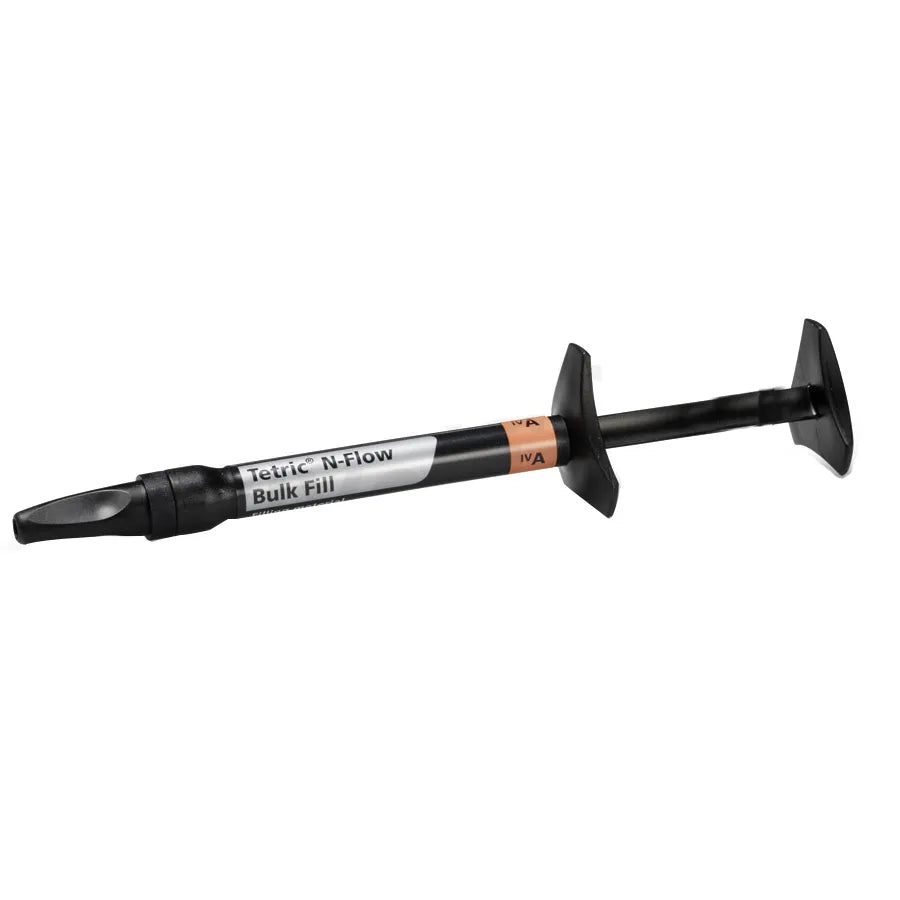
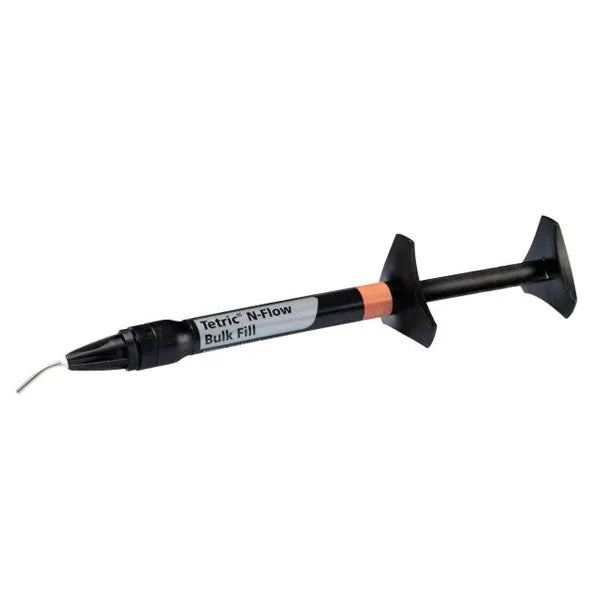
The new flowable composite complements the mouldable Tetric N-Ceram Bulk Fill composite. In essence, Tetric N-Flow Bulk Fill is based on the composition of Tetric N-Ceram Bulk Fill. The material is applied as a bulk-fill base in Class I and Class II restorations. Just like the existing version, it can be light-cured in large increments of up to four millimetres, requiring only short light exposure times. Excellent affinity to cavity walls and self-levelling consistency round off the benefits offered by this volume replacement material.
Aessencio technology
- Another strength of the new composite lies in the Aessencio technology. This technology causes the translucency of the material to decrease from 28% to approx. 10% during polymerization.
Indications
- As initial layer / first increment in Class I and II composite restorations in permanent teeth
- Restorations in deciduous teeth (without capping layer)
- ✓Giomer-based bulk-fill — no separate base layer needed
- ✓Fluoride-releasing and recharging for caries protection
- ✓Radiopaque — easily detectable on X-rays
- ✓Ideal for Class I and II cavities
- ✓4mm cure depth — saves chair time significantly
- ✓Low polymerization shrinkage — reduces sensitivity

Free Shipping
Free shipping on orders over 1999.

Support
24x7 Support

Secure Checkout
We ensure 100% Payment Secure.
The new flowable composite complements the mouldable Tetric N-Ceram Bulk Fill composite. In essence, Tetric N-Flow Bulk Fill is based on the composition of Tetric N-Ceram Bulk Fill. The material is applied as a bulk-fill base in Class I and Class II restorations. Just like the existing version, it can be light-cured in large increments of up to four millimetres, requiring only short light exposure times. Excellent affinity to cavity walls and self-levelling consistency round off the benefits offered by this volume replacement material.
Aessencio technology
- Another strength of the new composite lies in the Aessencio technology. This technology causes the translucency of the material to decrease from 28% to approx. 10% during polymerization.
Indications
- As initial layer / first increment in Class I and II composite restorations in permanent teeth
- Restorations in deciduous teeth (without capping layer)
Related Products
 -22%
-22%
 -30%
-30%
 -40%
-40%
 -17%
-17%
 -6%
-6%
 -25%
-25%
 -15%
-15%
 -14%
-14%
 -27%
-27%
 -22%
-22%
 -0.3%
-0.3%
 -3%
-3%


 -22%
-22%
 -38%
-38%